
Testing Services
Customized testing
A published method is written for the general case. Where yours is not the general case, the laboratory and the R&D centre next door build the fixture that answers it.
- Lowest rig temperature
- -196 °C
- Cryogenic rig developed in house for valves and connectors.
- Cracking pressure
- 0.2–5 bar
- Non-return valves, with minimum burst on the same fixture.
- Test fixtures
- In house
- Built by the DSIR-recognised R&D centre on the same site.
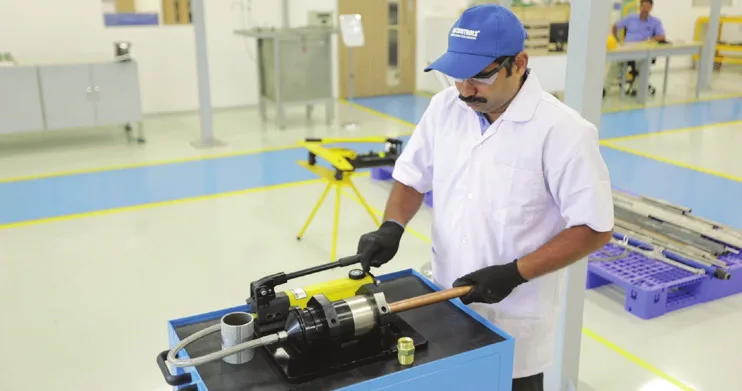
Test plans are drawn up by the engineers who design connectors, and a DSIR-recognised R&D centre on the same site builds any fixture that does not exist yet. The two programmes below were built that way.
The lifecycle
What we run
Fittings misalignment under vibration
Railway rolling stock does not present a fitting with a clean, coaxial load. It presents a pipeline slightly out of true, shaking, for years. So we built a rig that reproduces it: multiple lines, some deliberately misaligned, checked for leakage across a customer-specified frequency range.
Cryogenic testing to -196 °C
Cryogenic rigs are not something you order from a catalogue. Fluid Controls developed its own to qualify valves and connectors at liquid-nitrogen temperature - the same instinct that has produced more than twenty-five new products since 2011.
What we can show
Vibration and pressure impulse, combined
Applied together rather than one after the other, because that combination is what loosens a connection in service and either load alone under-tests it.
Valve cyclic endurance
Actuation to whatever cycle count the duty requires, on the valve reliability bench rather than extrapolated from a shorter run.
Make and break testing for connectors
Repeated assembly of a connection, to prove it still seals after the number of remakes maintenance will actually do to it.
Non-return valve cracking pressure
Opening pressure verified across the 0.2 to 5 bar range, with minimum burst measured on the same fixture.