
Services
Testing and metrology laboratory
The benches that qualify our own products are available to test yours - pressure, tightness, endurance, corrosion and material, with results documented to the standard you cite.
- Hydrostatic pressure
- 58,000 psi
- Maximum test pressure
- Reliability cycles
- 100,000
- On the reliability test machine
- Pneumatic pressure
- 20,000 psi
- Maximum test pressure
- Vacuum
- 750 mbar
- Maximum vacuum level
The laboratory at Chakan, Pune sits on the same site as manufacture and qualifies every Fluid Controls connection before it is sold. Customer connections, assemblies and bought-in parts are run to a defined programme on request, with documented results issued for your file.
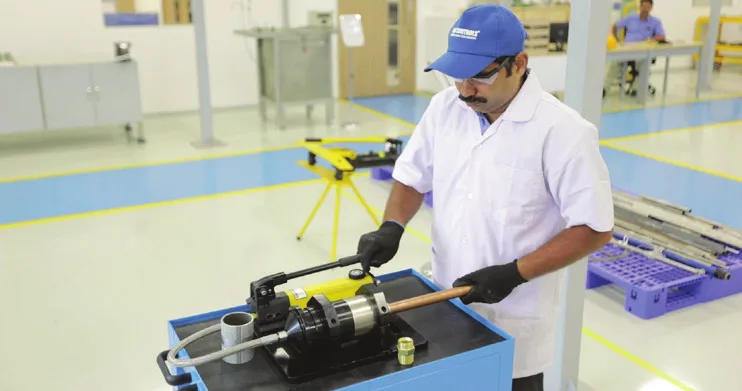
In the laboratory
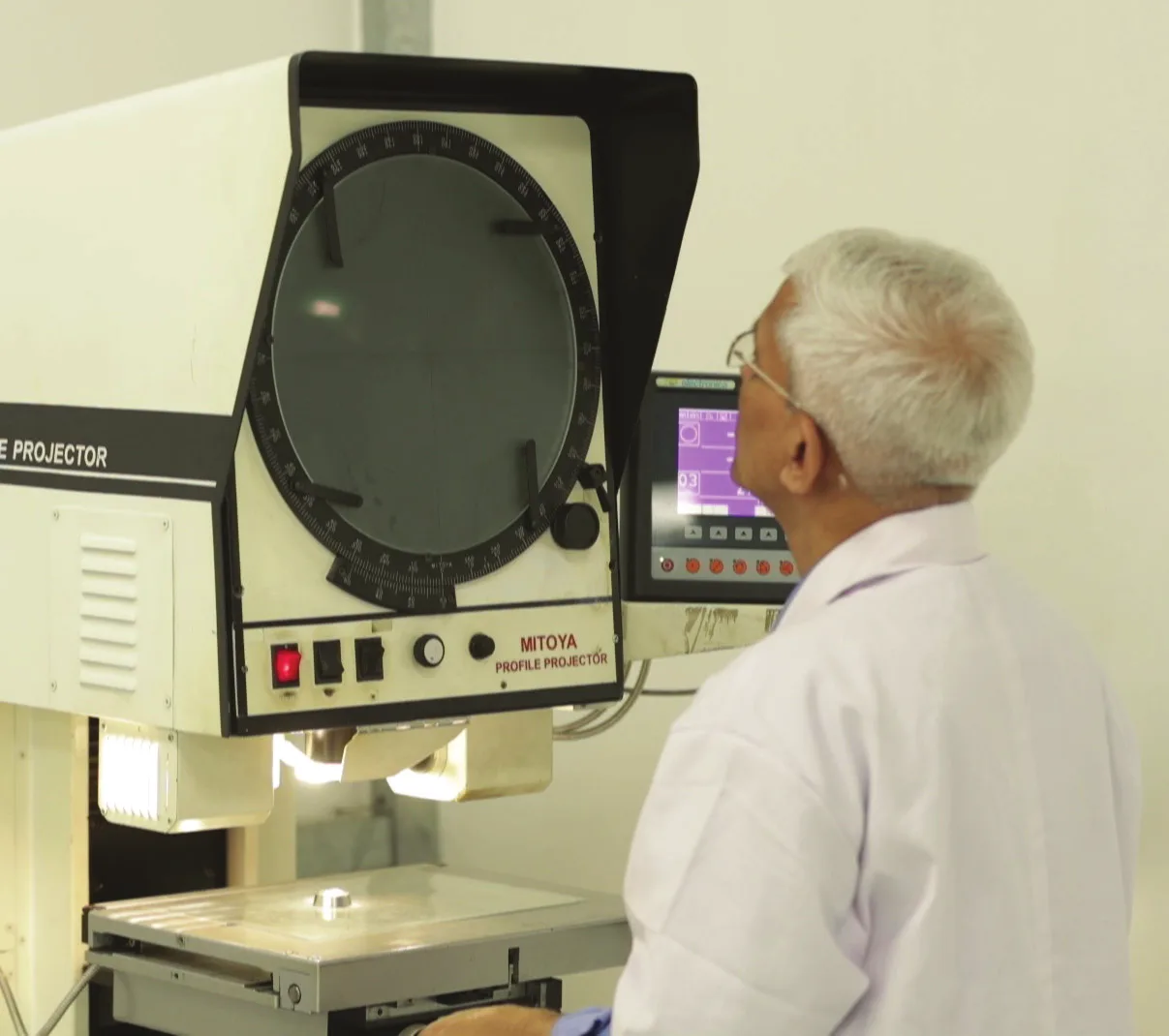
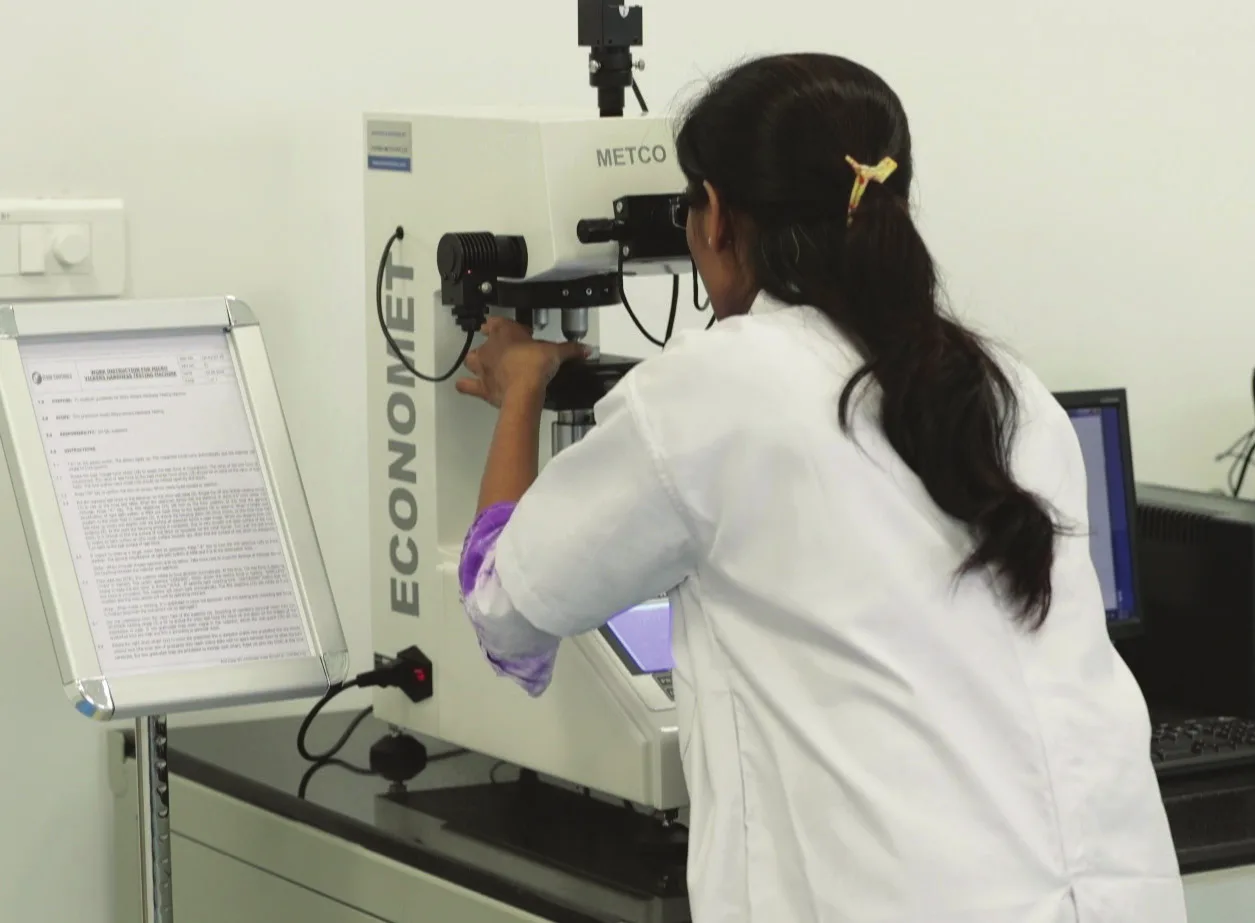
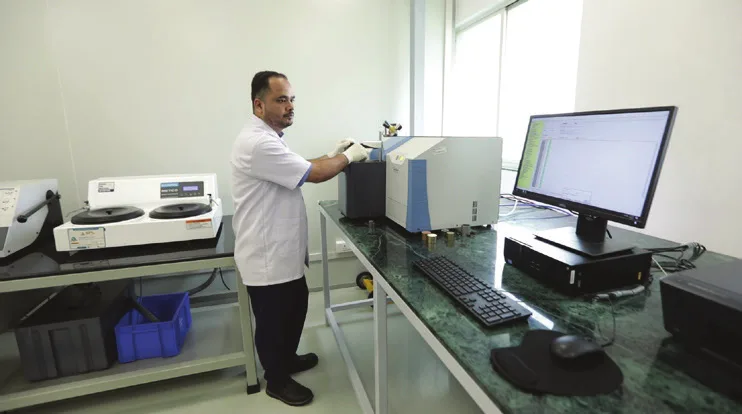
What we run
NABL accredited scope 7/14
Impulse & Fatigue Testing
Connections fail after thermal movement, after a hundred thousand pressure pulses, or after a year of vibration. None of which appears in a proof-pressure certificate. The SCADA multi-test bench applies those loads under programme control and logs the result as a history rather than a verdict.
Hydraulic impulse and vibration
NABL Accredited Test Laboratory | ISO/IEC 17025:2017 | TC-16263
ISO 19879 cl. 13Pressure pulses and vibration applied together rather than one after the other, because that combination is what loosens a connection in service and either load alone under-tests it.
Temperature cycling
Repeated thermal cycling to load the differential expansion between body, ferrule and tube - the mechanism a room-temperature test cannot reach.
Flexure fatigue and rotary flexure
NABL Accredited Test Laboratory | ISO/IEC 17025:2017 | TC-16263
ARP 1185 cl. 4.0Bending applied repeatedly, and rotating bending, to qualify a connection against the line movement it will actually see on a skid or a bogie.
Reliability testing
A dedicated reliability machine running a connection or valve to 100,000 cycles, for duties where the part is actuated rather than installed once.
Pressure Testing
Leak & Vacuum Testing
Pressure decay shows that a joint is not leaking badly, not that it is tight. The distinction that decides the specification on analyser lines, vacuum service and process gas. Both methods below run on customer parts as well as our own.
Vacuum testing
NABL Accredited Test Laboratory | ISO/IEC 17025:2017 | TC-16263
ISO 19879 cl. 10Vacuum drawn and held to 750 mbar, for connections that will see sub-atmospheric service - where the load on a seal reverses and a joint that is tight under pressure can still draw in.
Leakage testing
NABL Accredited Test Laboratory | ISO/IEC 17025:2017 | TC-16263
ISO 19879 cl. 6Leak testing to ISO 19879 clause 6, accredited under our NABL ISO/IEC 17025 scope, for joints that have to be shown tight rather than assumed tight. The acceptance rate is set by the standard the part is qualified against and is confirmed when the programme is scoped.
Helium leak testing (on request)
Mass-spectrometer detection using helium as the tracer gas, for joints where a pressure-decay test is not sensitive enough to prove the result. Arranged as per customer requirement rather than run as standard, and outside our NABL accredited scope. The detectable rate depends on part geometry and is agreed when the programme is scoped.
Material & Mechanical Testing
A material certificate describes a heat, not the part in hand. The three methods below establish what the alloy is, whether the body is sound inside, and what the finished joint holds.
Positive material identification (PMI)
Alloy verification on the finished part rather than on paper, so the material certificate and the metal it describes are the same claim. Run in house before dispatch, and available on customer parts.
Ultrasonic testing
Volumetric inspection for internal discontinuities in bar stock and finished bodies - the defects that no dimensional or surface check will ever see.
Tensile pull testing
Axial load applied to a made-up connection until it separates, on the SCADA multi-test bench. It proves the grip of the ferrule on the tube, which is a different question from the strength of the tube itself.
Joint strength testing
NABL Accredited Test Laboratory | ISO/IEC 17025:2017 | TC-16263
AS 18280 cl. 4.4.9Axial load applied to a made-up joint to the strength requirement of AS 18280, accredited under our NABL ISO/IEC 17025 scope. It qualifies the connection rather than the tube: what is being proved is that the joint holds to the figure the standard sets for that size and series.
Reuse capability testing
NABL Accredited Test Laboratory | ISO/IEC 17025:2017 | TC-16263
AS 2094 cl. 4.8Whether a connection may be broken, remade and returned to service, to AS 2094. Accredited, and a different question from repeated assembly. Repeated assembly asks how many remakes a fitting survives; reuse capability asks whether a given one is fit to go back in.
Corrosion Testing
Both programmes below are reported against their ASTM designation rather than as hours survived, so results stay comparable. If your specification cites a different classification, state it at enquiry: the apparatus is the same, the class the result is reported against is not.
Salt spray testing
NABL Accredited Test Laboratory | ISO/IEC 17025:2017 | TC-16263
ASTM B117Corrosion resistance of plating assessed by the salt spray (fog) method, for plating classified to ASTM B840. Reported against the class the specification calls for.
Stress corrosion testing
Connections held under load in a corrosive environment, to the stress-corrosion requirement of ASTM F1387 - the failure mode that needs stress and environment together, and that neither a tensile test nor a salt-spray run finds on its own.
Standards applied
ASTM F1387
Performance of piping and tubing mechanically attached fittings, whose impulse, vibration and flexure requirements define the programmes above.
ASTM B840 : 2002
Classification of plating for corrosion resistance. The classification the salt-spray result is reported against.
ASTM B117
Standard practice for operating salt spray (fog) apparatus. The method by which the exposure itself is run.
Documents
- NABL scope of accreditation (TC-16263)The annexure behind every accredited badge above: each test named with the standard and clause it is accredited under.
- NABL accreditation certificate (ISO/IEC 17025:2017)The certificate itself, for the Performance Testing and Metrology laboratories at Chakan.