
Testing Services
Product performance validation
Prototype and sample type-testing that either reproduces the conditions a connection will meet in service, or deliberately exceeds them until it gives way - and reports which.
- What we run
- 17
- NABL accredited scope
- 8/17
- Standards applied
- 8
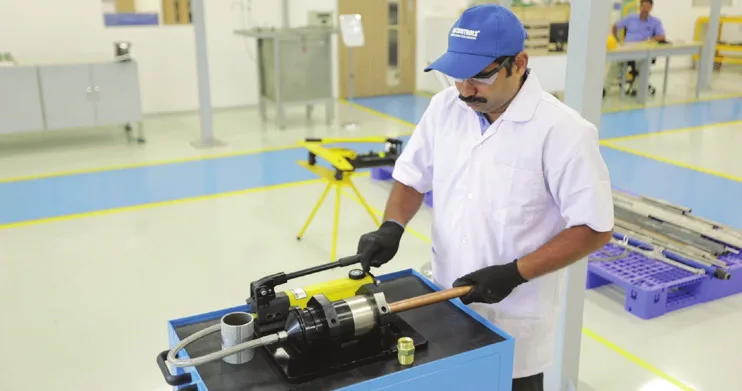
Seventeen tests covering the loads a connection meets in service. Pressure held and pulsed, vibration, bending, thermal movement, salt, and the loads it is not meant to meet, up to burst. Pressure to 4,000 bar and temperature from liquid nitrogen to 537 °C, on prototypes, on production samples, and on parts you send us.
What we run
NABL accredited scope 8/17
Hydrostatic proof and high-pressure test
NABL Accredited Test Laboratory | ISO/IEC 17025:2017 | TC-16263
Water held at pressure to prove a joint neither leaks nor deforms at the rating you intend to publish for it.
Pneumatic proof and high-pressure test
NABL Accredited Test Laboratory | ISO/IEC 17025:2017 | TC-16263
The same proof with a compressible medium, for connections whose service fluid is a gas and whose failure mode therefore is not the same one.
Hydrostatic burst test
NABL Accredited Test Laboratory | ISO/IEC 17025:2017 | TC-16263
Pressure raised until the connection gives way, which is the only way to know the margin between the rating and the limit rather than assuming it.
Vibration test
Swept and held frequencies to 60 Hz, for equipment that spends its life on a bogie, a skid or a compressor rather than on a bench.
Impulse test
NABL Accredited Test Laboratory | ISO/IEC 17025:2017 | TC-16263
Rapid pressure pulses repeated to the count the standard requires, because almost nothing in hydraulics fails on its first cycle.
Flexure fatigue test
NABL Accredited Test Laboratory | ISO/IEC 17025:2017 | TC-16263
Bending applied repeatedly at the joint, to qualify a connection against the line movement a real installation puts through it.
Salt spray test
Corrosion resistance of plating assessed by the salt spray (fog) method, reported against the class your specification names.
Salt mist test
NABL Accredited Test Laboratory | ISO/IEC 17025:2017 | TC-16263
The environmental-testing variant of the same exposure, for equipment qualified to an IEC environmental sequence rather than to a plating class.
Rotary flex test with S-N curve
NABL Accredited Test Laboratory | ISO/IEC 17025:2017 | TC-16263
Rotating bending to failure across a range of stress levels, producing a curve rather than a pass - the form a fatigue allowable has to be quoted in.
Vacuum test
Vacuum drawn and held, for connections that see sub-atmospheric service, where the load on a seal reverses and a joint that is tight under pressure can still draw in.
Cryogenic test
Valves and connectors qualified at liquid-nitrogen temperature, on a setup Fluid Controls developed in house because no catalogue rig covered it.
Cracking pressure and minimum burst
The pressure at which a non-return valve first opens, and the minimum it will hold - the two numbers that decide whether it protects the circuit behind it.
High-pressure thermal cycling
Pressure and temperature cycled together to 537 °C, to load the differential expansion between body, ferrule and tube that a room-temperature test cannot reach.
Spring load test
Spring rate and set load measured on the apparatus, for the components whose behaviour is a force-displacement curve rather than a pressure rating.
Repeated assembly test
NABL Accredited Test Laboratory | ISO/IEC 17025:2017 | TC-16263
Fittings and hose assemblies made and broken repeatedly, to prove the joint still seals after the number of remakes maintenance will actually do.
Maximum torque test
Clamps and bolted joints taken to 800 Nm, which establishes the margin between the assembly torque you publish and the one that damages the part.
Valve cyclic endurance test
A valve actuated to 100,000 cycles on the reliability bench, for duties where the part is operated rather than installed once and left.
Standards applied
ASTM F1387
Performance of piping and tubing mechanically attached fittings. The impulse, flexure, rotary-flexure, repeated-assembly and burst requirements most of the programmes above are run to.
ISO 19879
Test methods for hydraulic fluid power connections: proof, burst, leakage, cyclic endurance and vacuum.
EN 61373
Shock and vibration for equipment mounted on railway rolling stock, which is where the vibration programme takes its severity categories from.
ASTM B117
Standard practice for operating salt spray (fog) apparatus - the method by which the exposure itself is run.
BS 6364 / APIS / ISO 15548
Cryogenic valves. The three documents cited against the cryogenic row of the testing schedule, as printed there.
BS EN 854
Textile-braid hydraulic hose. Cited against the proof, impulse and repeated-assembly rows, where the part under test is a hose assembly rather than a fitting.
IEC 60068
Environmental testing. The sequence the salt mist exposure is run to where a specification qualifies equipment rather than a plating class.
AS 18280 · AS 2094
Cited by Fluid Controls alongside ASTM F1387 and ISO 19879 against the proof, impulse, flexure, rotary-flexure and repeated-assembly rows of its published testing schedule.
What we can show
Aerospace rig for S-N flexure
A rig held for rotary-flexure work to aerospace requirements, listed among the laboratory's own facilities rather than adapted from the general bench when a programme asks for it.
Aerospace setup for impulse, proof pressure and repeated testing
A separate aerospace test setup covering impulse, proof pressure and repeated testing, so a programme written to an aerospace specification runs on equipment kept for it.